




Dear friends,
Of the five senses, four are intermediaries between the external world and the mind-body unity, and one is distinctly not: the one with the power to bring you back instantly to a moment, a memory, a person, a time. In our nervous systems, the sense of smell carries a blend of emotions with a smooth yet meaningful impact.
Sight, sound, taste, and touch all reach our mind-body through a relay station deep in the brain, the thalamus, which sorts the information before passing it on for interpretation. Smell alone circumvents this indirect process. The olfactory signal, travelling through the smell receptors in our nerves, reaches almost directly into the oldest part of the brain, the centre of emotion and memory, arriving there before the thinking mind has had a chance to catch up.
The consequence is familiar to everyone as a strong, ineffable feeling. A scent caught in passing can return you to a moment thirty years gone with a completeness no photograph achieves. The novelist Marcel Proust built seven volumes on the sensation: a taste and its scent dissolving the decades in an instant. Psychologists now call it, without irony, the Proust effect.
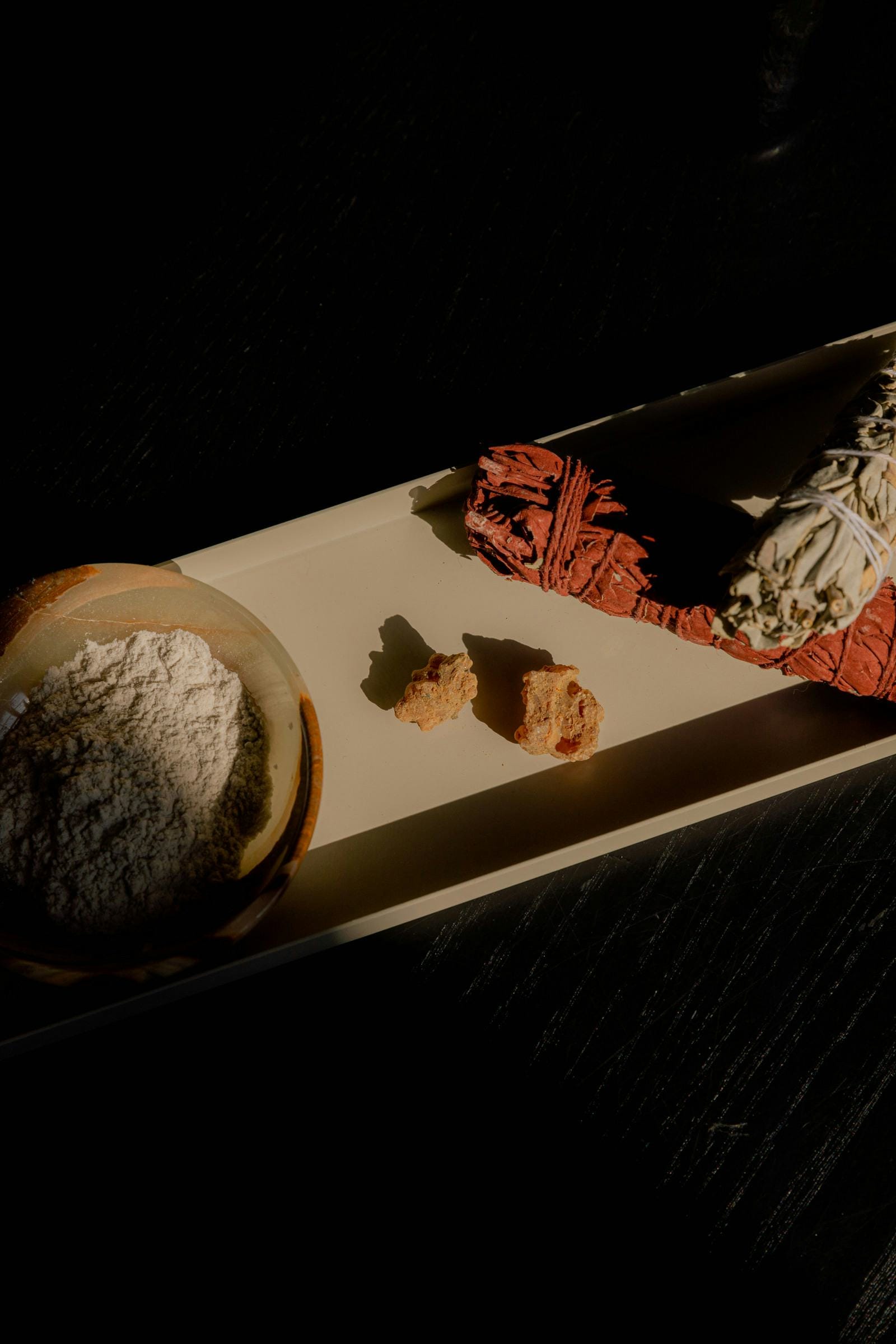
Incense in its raw form, before it becomes smoke
Because it reaches us so directly, scent has always been enlisted as a medium for traditional practices where words fall short. Incense rises in nearly every belief system on earth, in the houses of healing of Anatolia, the temples of the East, the smoke of burning herbs across the steppe, not by coincidence, but because rising, fragrant smoke does something words cannot: it changes the air of a room, and with it, the state of the body breathing that air.
Modern research has begun to describe, in its own vocabulary, what ritual innately already knew. A 2024 paper in Science Advances mapped how deeply the sense of smell is bound up with our wellbeing, our mood, our stress, even our satisfaction with life, and argued that we have only begun to trace its reach. The psychologist Rachel Herz of Brown University, who has studied odour and memory for three decades, has found that memories summoned by scent arrive more emotionally charged, and feel more vivid, than the same memories called up by a word or an image. The nose, it seems, does not merely recall the past; it reassembles a version of it for our mind to apprehend.
With modern biofield energy studies of aromatherapy, we can see these complex systems at work through new measuring technologies. A 2022 study using electroencephalography (EEG) to track how inhaling various essential oils alters the brain's electrical activity found significant increases in alpha wave oscillations, the pattern that corresponds with states of physical relaxation.
Anna Drobina, a transpersonal psychologist who works with scent, incense, and aromatherapy, has spent years attending to exactly this threshold, the point where a smell becomes a state of mind. Her interest is less in fragrance for its own sake than in what scent reaches: the parts of a person that language cannot easily approach, and that sometimes answer more readily to a breath of woodsmoke or resin than to any question.
“Scent doesn’t ask you to understand anything. It simply reaches you.”
Anna Drobina

Anna Drobina, who works at the threshold where a scent becomes a state of mind
There is something quietly consoling in all of this. We tend to think of memory as a faculty of the mind, kept in the brain, retrieved by effort. Yet its most faithful keeper may be the sense we trust the least with serious things, the one that asks nothing of us but a breath. It holds what we thought we had lost and returns it, unbidden, on an ordinary afternoon.
Which scent affects you the most?
Tap whichever one is true for you, and we’ll help you find out why.
|
Sources & further reading Halligudi, N., & Al Ojaili, M. (2013). The science and art of aromatherapy: A brief review. Journal of Biomedical and Pharmaceutical Research, 2(2), 6–14. Bratman, G. N., et al. (2024). Nature and human well-being: the olfactory pathway. Science Advances, 10(20), eadn3028. Choi, N.-Y., Wu, Y.-T., & Park, S.-A. (2022). Effects of olfactory stimulation with aroma oils on psychophysiological responses of female adults. International Journal of Environmental Research and Public Health, 19(9), 5196. Herz, R. S. (2016). The role of odor-evoked memory in psychological and physiological health. Brain Sciences, 6(3), 22. The term “the Proust effect” takes its name from Marcel Proust, In Search of Lost Time (1913), whose narrator is returned to childhood by a scent and a taste. |
With warm regards
The Harmony Spiritus Team
|
Next Friday What the hand knows On clay, and thinking with the body |
If someone comes to mind as you read this, pass it on.